


Zhidoynskoye deposit:
Development and Collaboration Prospects
Establish a modern diversified enterprise for the mining and deep processing of complex titanium-apatite ores
Project Objective
General Information
Infrastructure:
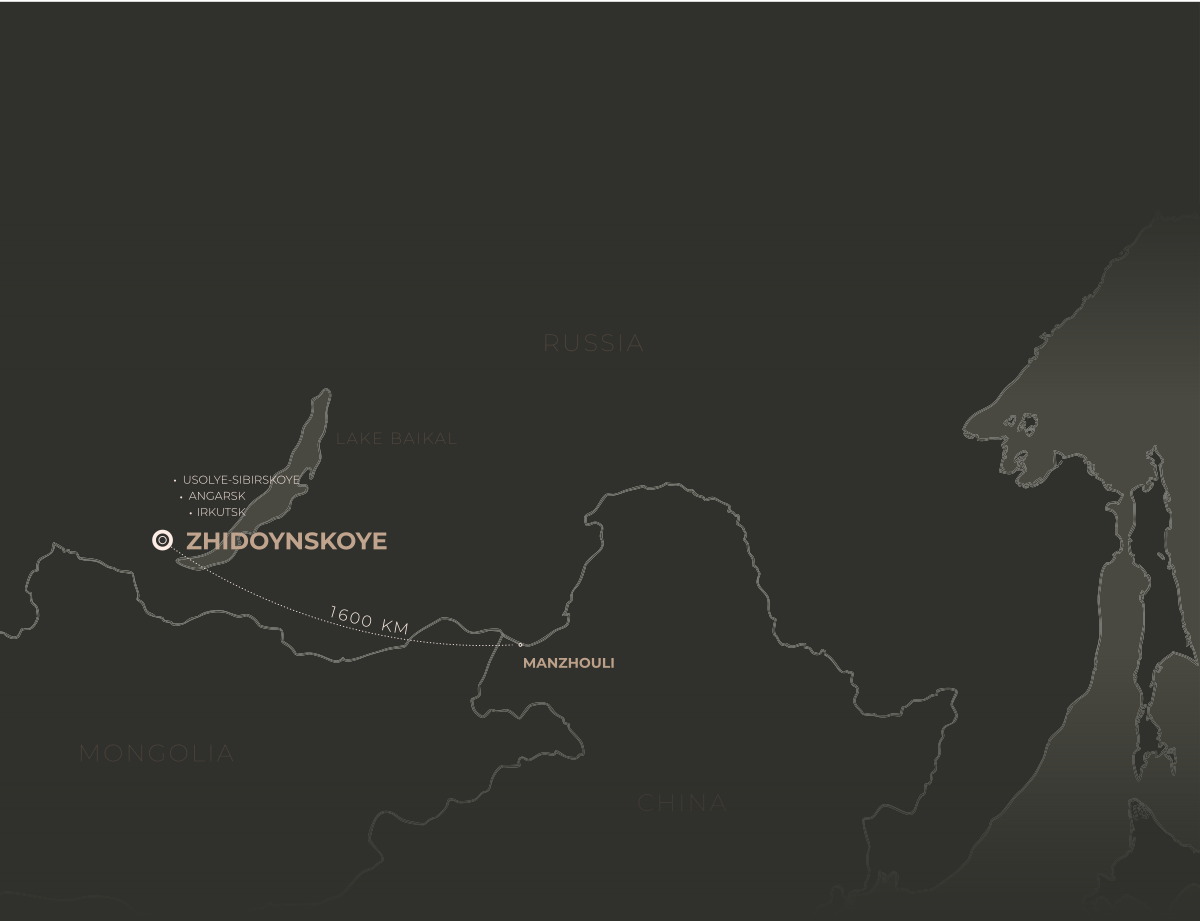
- Proximity to industrial centers: the cities of Irkutsk, Angarsk, and Usolye-Sibirskoye
- Transport accessibility
- Developed power grid
- Proximity to the Power of Siberia 2 gas pipeline and gas utilization potential
- Distance to China (Manzhouli): 1,600 km
- Availability of skilled labor
Location:
License:
Stage:
- Irkutsk Region
License:
- Owned by LLC "Tiomin Resource Baikal"
Stage:
- Prospecting and evaluation works completed
1. Geological exploration:
During 2013−2024, the Bolshezadoysky area underwent prospecting and evaluation, including 2,744 linear meters of trenching and 10,628 linear meters of core drilling, along with metallurgical testing; within an area of approximately 1.0 km2, ore pyroxenite deposits with commercial reserves were evaluated at depths of 0−350 m (Zhidoy deposit).
As a result of geological exploration, it has been established that the apatite-perovskite-titanomagnetite mineralization associated with the pyroxenites of the Zhidoy alkaline-ultramafic pluton is of commercial interest. Three ore bodies of pyroxenite with commercial mineralization have been outlined and evaluated at the deposit, with a strike length of 680−1,270 m, horizontal thickness ranging from 25 to 370 m, and traced to a depth of 230 to 340 m; the primary valuable components are TiO2, Fetotal, and P2O5.
The ore bodies have been explored on a 200−400 m * 150−75 m grid to a depth of 200−300 m from the surface, providing the drill hole density required to estimate Category C2 reserves for Group 2 deposits (moderately complex geological structures), to which the Zhidoy deposit is assigned.
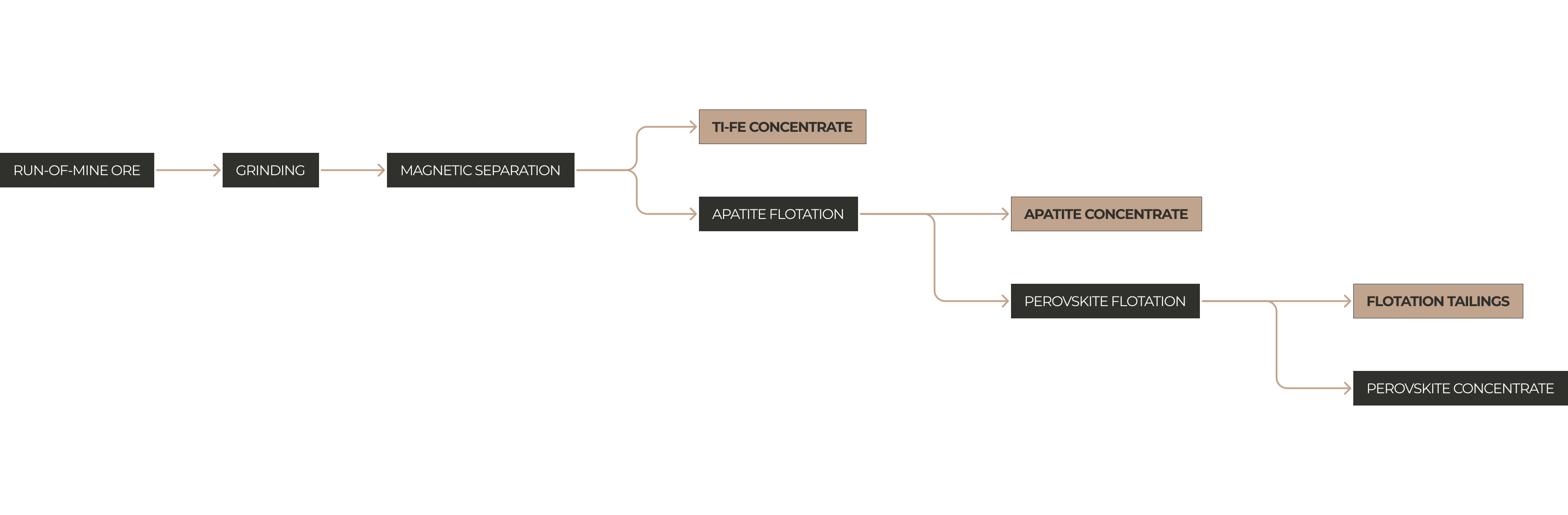
Metallurgical testing has evaluated the material composition and processing properties of the apatite-perovskite-titanomagnetite ores and proved the feasibility of their beneficiation using a combined flowsheet—incorporating magnetic separation followed by apatite and perovskite flotation—to produce titanomagnetite, titanium, and apatite concentrates.
Preliminary exploration parameters for open-pit mining were developed and submitted for review. In accordance with these parameters, ore and mineral component reserves within the pyroxenites of the Bolshezadoysky area were calculated; Category C2 balance reserves amounted to: Ore: 218.9 million tons, TiO2: 17,305 thousand tons, Fetotal: 28,774 thousand tons, P2O5: 6,279 thousand tons.
Category P1 inferred resources within the license area down to the -250 m horizon were estimated across two calculation blocks and amount to 91,205.8 thousand tons of ore, 7,209.0 thousand tons of titanium dioxide, 12,744.2 thousand tons of iron, and 2,642.4 thousand tons of phosphorus pentoxide. Technical and economic assessments have demonstrated that, given current mining and processing costs alongside prevailing market prices for the recoverable minerals, open-pit mining of the deposit’s reserves is economically viable.
The balance reserves of perovskite and apatite ores, calculated within the boundaries of an economically viable open pit, will support a processing plant with a capacity of 5,000 thousand tons per year for 39 years. Furthermore, the potential to expand the mineral resource base of the future mining enterprise is not yet exhausted.
Reserve growth is possible by bringing into operation sections of the ore bodies that extend beyond the boundaries of license IRK 2 912 TR, where Category P1 inferred resources of pyroxenites are estimated at: Ore: 63,042.0 thousand tons, Titanium dioxide (TiO2): 5,367.8 thousand tons, Iron (Fe): 8,579.4 thousand tons, Phosphorus pentoxide (P2O5): 1,779.0 thousand tons.
During 2013−2024, the Bolshezadoysky area underwent prospecting and evaluation, including 2,744 linear meters of trenching and 10,628 linear meters of core drilling, along with metallurgical testing; within an area of approximately 1.0 km2, ore pyroxenite deposits with commercial reserves were evaluated at depths of 0−350 m (Zhidoy deposit).
As a result of geological exploration, it has been established that the apatite-perovskite-titanomagnetite mineralization associated with the pyroxenites of the Zhidoy alkaline-ultramafic pluton is of commercial interest. Three ore bodies of pyroxenite with commercial mineralization have been outlined and evaluated at the deposit, with a strike length of 680−1,270 m, horizontal thickness ranging from 25 to 370 m, and traced to a depth of 230 to 340 m; the primary valuable components are TiO2, Fetotal, and P2O5.
The ore bodies have been explored on a 200−400 m * 150−75 m grid to a depth of 200−300 m from the surface, providing the drill hole density required to estimate Category C2 reserves for Group 2 deposits (moderately complex geological structures), to which the Zhidoy deposit is assigned.
Metallurgical testing has evaluated the material composition and processing properties of the apatite-perovskite-titanomagnetite ores and proved the feasibility of their beneficiation using a combined flowsheet—incorporating magnetic separation followed by apatite and perovskite flotation—to produce titanomagnetite, titanium, and apatite concentrates.
Preliminary exploration parameters for open-pit mining were developed and submitted for review. In accordance with these parameters, ore and mineral component reserves within the pyroxenites of the Bolshezadoysky area were calculated; Category C2 balance reserves amounted to: Ore: 218.9 million tons, TiO2: 17,305 thousand tons, Fetotal: 28,774 thousand tons, P2O5: 6,279 thousand tons.
Category P1 inferred resources within the license area down to the -250 m horizon were estimated across two calculation blocks and amount to 91,205.8 thousand tons of ore, 7,209.0 thousand tons of titanium dioxide, 12,744.2 thousand tons of iron, and 2,642.4 thousand tons of phosphorus pentoxide. Technical and economic assessments have demonstrated that, given current mining and processing costs alongside prevailing market prices for the recoverable minerals, open-pit mining of the deposit’s reserves is economically viable.
The balance reserves of perovskite and apatite ores, calculated within the boundaries of an economically viable open pit, will support a processing plant with a capacity of 5,000 thousand tons per year for 39 years. Furthermore, the potential to expand the mineral resource base of the future mining enterprise is not yet exhausted.
Reserve growth is possible by bringing into operation sections of the ore bodies that extend beyond the boundaries of license IRK 2 912 TR, where Category P1 inferred resources of pyroxenites are estimated at: Ore: 63,042.0 thousand tons, Titanium dioxide (TiO2): 5,367.8 thousand tons, Iron (Fe): 8,579.4 thousand tons, Phosphorus pentoxide (P2O5): 1,779.0 thousand tons.
2. Ore processing:
The ore processing technology for the Zhidoy deposit under a contract with Tiomin Resource Baikal LLC was developed by Irkutsk State Technical University (2013), NVP Center-ESTAgeo LLC (2023), IRGIREDMET JSC (2024), and KSC RAS (2025-2026).
The conducted technological studies have examined the material composition and technological properties of apatite-perovskite-titanomagnetite ores and proved the possibility of their processing according to a combined scheme, including magnetic separation followed by apatite and perovskite flotation, with the production of titanomagnetite, titanium and apatite concentrates.
The ore processing technology for the Zhidoy deposit under a contract with Tiomin Resource Baikal LLC was developed by Irkutsk State Technical University (2013), NVP Center-ESTAgeo LLC (2023), IRGIREDMET JSC (2024), and KSC RAS (2025-2026).
The conducted technological studies have examined the material composition and technological properties of apatite-perovskite-titanomagnetite ores and proved the possibility of their processing according to a combined scheme, including magnetic separation followed by apatite and perovskite flotation, with the production of titanomagnetite, titanium and apatite concentrates.
Recovery indicators (Irgiredmet)

The processing technology for the ore pyroxenites of the Zhidoy deposit was refined under pilot-scale conditions at the Kola Science Center of the Russian Academy of Sciences (KSC RAS), Apatity.
The following were obtained during the tests:
The following were obtained during the tests:
- titanomagnetite concentrate with a content of 60.71% Fe total at 54.45% recovery;
- apatite concentrate with a content of 36.24% P2O5 at 66.79% recovery;
- apatite concentrate with a content of 38.09% P2O5 at 47.77% recovery;
- perovskite concentrate with a content of 35.81% TiO2 at 32.09% recovery.
3. Hydrometallurgical processing of enrichment products:
Hydrometallurgical processing studies were conducted at ICTREMS KSC RAS using titanium concentrate samples with TiO2 content ranging from 15% to 35%. The technological scheme selected for the research involved autoclave sulfuric acid decomposition of the titanium concentrate.
Hydrometallurgical processing studies were conducted at ICTREMS KSC RAS using titanium concentrate samples with TiO2 content ranging from 15% to 35%. The technological scheme selected for the research involved autoclave sulfuric acid decomposition of the titanium concentrate.
Principal technological scheme for titanium concentrate processing
Chemical composition of rutile

5. Production of Ti-Al alloy from synthetic rutile
Experiments on aluminum reduction of rutile concentrate were conducted in atmospheric conditions using a prototype of synthetic rutile obtained during the sulfuric acid processing of titanium concentrate. Intermetallic compounds of the Ti-Al family are lightweight and possess excellent heat resistance, possessing both high ductility and high strength.
As a result of aluminothermic reduction, the products were obtained—an ingot and slag.


Geology and reserves
Ore types:
Apatite-perovskite-titanomagnetite
Industrial mineralization is associated with pyroxenites of an alkaline-ultrabasic pluton.
Apatite-perovskite-titanomagnetite
Industrial mineralization is associated with pyroxenites of an alkaline-ultrabasic pluton.
Прогнозные ресурсы:
- Ore: 311.4 million tons
- TiO₂: 25.2 million tons
- Fe: 41.8 million tons
- P₂O₅: 8.98 million tons
Balance reserves:
- Ore: 218.9 million tons
- TiO₂: 17.3 million tons
- Fe: 29.2 million tons
- P₂O₅: 6.3 million tons
processing technology
Recovery:
- TiO₂: 26.8%
- Fe: 60.1%
- P₂O₅: 80.2%
Flowsheet:
- Magnetic separation → Ti-Fe concentrate (64% Fe, 10% TiO₂)
- Flotation → Apatite (39% P₂O₅) and titanium (23% TiO₂) concentrates
Process flowsheet:

The developed processing technology is being refined under pilot-scale conditions at the KSC RAS, Apatity
processing technology
Recovery:
- TiO₂: 26.8%
- Fe: 60.1%
- P₂O₅: 80.2%
Flowsheet:
- Magnetic separation → Ti-Fe concentrate (64% Fe, 10% TiO₂)
- Flotation → Apatite (39% P₂O₅) and titanium (23% TiO₂) concentrates
Process flowsheet:
The developed processing technology is being refined under pilot-scale conditions at the KSC RAS, Apatity
Hydrometallurgical processing
Method: Autoclave sulfuric acid decomposition of titanium concentrate
Product: Synthetic rutile (98% TiO₂)
Application: Pigments, titanium sponge
Product: Synthetic rutile (98% TiO₂)
Application: Pigments, titanium sponge
Chemical composition of rutile

Pyrometallurgy
and alloys
and alloys
Carbothermic reduction:
Aluminothermy:
Production of Ti-Al alloys (Al₃Ti, TiC)
Application:
- Obtaining Ti-Fe product
Aluminothermy:
Production of Ti-Al alloys (Al₃Ti, TiC)
Application:
- Aerospace industry, chemical engineering.
Project implementation stages
2026–2027
Pilot-scale industrial testing (KSC RAS)
2028–2029
Construction of a processing plant
2030–2031
Reaching full capacity
news
To investors
Zhidoy deposit has significant potential for the supply of titanium and phosphate raw materials.
Prospective areas of cooperation:
Prospective areas of cooperation:
- Optimization of beneficiation and processing with the involvement of technologies
- Creation of joint ventures for high-margin products (pigments, alloys)
Limited Liability Company Tiomin Resource Baikal
ИНН 380822450
КПП 380801001
ОГРН 1113850037663
664003, Russian Federation, Irkutsk,
Dzerzhinskogo st., 1, 9th floor, office 902
tel: +7 (3952) 791000 | email: info@omega.irk.ru
ИНН 380822450
КПП 380801001
ОГРН 1113850037663
664003, Russian Federation, Irkutsk,
Dzerzhinskogo st., 1, 9th floor, office 902
tel: +7 (3952) 791000 | email: info@omega.irk.ru